How is this any different from MTR's line of products?[1]
And given that MTR's products cost just $2.50 per pack where I currently live, $24 isn't exactly cheap. I haven't tasted your product, but I have tasted the MTR ones and they seem pretty authentic. And MTR being a very old, traditional brand, it's as authentic as it gets. Would love to hear about your differentiation strategy.
- MTR provides just the spices, you have to bring everything else. This includes vegetables/meat, seasoning, additional spices, oil/salt, etc. Our products include all of this so that the only ingredient you add is water which makes it much more convenient.
- Our packets are 100% fresh and don't have any preservatives, whereas existing packaged Indian foods are packed with them. This makes our products tastier, fresher and much healthier, although it comes with a shorter shelf-life.
- Our recipes are curated from people in the community (for example, the rasam is my mom's!) This lends a very homemade taste to each dish.
- We deliver to you! All existing pre-packaged authentic Indian foods are only available in Indian stores, so we're making good Indian food available to a much larger audience.
- At the end of the day, the taste just isn't comparable. Microwaveable chana masala from Haldiram's, let's say, comes out looking/smelling/tasting not at all like a homemade dish. Ours is made completely from scratch and you as a customer can feel that difference.
MTR/Haldiram's are 'last-resort' type meals, and we aim to be a meal that you actually crave + is good for you :)
> MTR provides just the spices, you have to bring everything else. This includes vegetables/meat, seasoning, additional spices, oil/salt, etc. Our products include all of this so that the only ingredient you add is water which makes it much more convenient.
Sorry, this is not accurate. If I buy an MTR Sambhar rice, or Paneer masala, everything is included. I just need to heat it and eat it.
> Our packets are 100% fresh and don't have any preservatives, whereas existing packaged Indian foods are packed with them. This makes our products tastier, fresher and much healthier, although it comes with a shorter shelf-life.
I can't vouch for the freshness of MTR's products, but I know they don't use preservatives (as it's printed on their cartons). They use a combination of food engineering and package engineering to preserve the food without using preservatives. That's why when you buy their ready to eat products, you will find a lot of oil in them (which you're supposed to drain away) as it helps to preserve the food for months, if not years. This is no different than storing dead specimens such as rats in biological laboratories, I assume.
> Our recipes are curated from people in the community (for example, the rasam is my mom's!) This lends a very homemade taste to each dish.
Ok, this sounds good.
> We deliver to you! All existing pre-packaged authentic Indian foods are only available in Indian stores, so we're making good Indian food available to a much larger audience.
So, basically a uber type of service? So that almost makes you guys like any other restaurant, no? I mean, what's the difference between calling an Indian restaurant to have fresh food delivered vs calling you guys?
> At the end of the day, the taste just isn't comparable. Microwaveable chana masala from Haldiram's, let's say, comes out looking/smelling/tasting not at all like a homemade dish. Ours is made completely from scratch and you as a customer can feel that difference.
This is subjective. Like I said, if you call up a decent Indian restaurant (HSB / Anjappar / Raj / etc.), you can get a similar experience.
> MTR/Haldiram's are 'last-resort' type meals, and we aim to be a meal that you actually crave + is good for you :)
Sorry, but I am still not convinced why your product is worth $24 and based on what you answer, seems like there isn't much difference between ordering from a decent Indian restaurant and you guys?
I appreciate taking the time to explain your points so far.
That's fine, but then the question becomes "How many people who want fancy 'high quality' Indian food also live far from decent Indian food". At this price point, your demographic seems to be people who have a decent amount of disposable income who also want QUALITY Indian food who also don't want to have to prepare it themselves and who don't live near Indian restaurants of comparable quality to the product. How much of that 5 Billion dollar pie have you carved away from your product when it's framed like that?
I have to agree with OP. I wish you well, but if I want to pay this much money for Indian food I'll likely go to an Indian Restaurant near me. I'm supporting a local business and being provided with a restaurant experience.
(of note: I worked in restaurants for over a decade, so my food spending tends to fall into "dining experience at a great restaurant" or "ingredients to prepare my own food because it's cheaper than convenience foods". I was going to be a hard sell from the start).
That's a fair point, but also not the only demographic. When the options are either eat at an Indian restaurant or make it yourself, you come up against issues of overspending on time or money. There's a large population of people who enjoy Indian food, live near restaurants, could even make it themselves if they want to, but would rather get a quick, tasty meal that tastes homemade for the same amount of money and effort as a microwave meal.
There's also the group of first generation Indians who have kids, would like to feed their kids Indian food, but don't have an hour each day after work to prepare a fresh meal. Combining these packets with homemade daal and rice would make an easy weekday meal for a small family (although in NYC you can find housewives who'll come to your house once a week and prepare a week's worth of fresh food for cheaper than these packets).
Coming from small-town Missouri and having traveled very little even within the US, I had literally never heard of any specific Indian dish (authentic or not) until I moved to San Francisco. I had no idea what naan or chicken tikka masala were until my company in SF ordered some.
So before you moved to SF, you never ate any of these products. Most people don't start eating new cuisines from a product like this, they start at restaurants (under the assumption that these cooks have experience cooking the food and will likely make a good product) or after having a meal prepared for them by another person.
That's not to say you wouldn't see this product at a store and go "oh, I've heard of Indian food and always been interested!" but that's not the common buyer behavior. People tend to pick convenience foods based on established food preferences/familiarizes.
- The microwaveable complete meals are definitely more similar to our products, but those are once again shelf-stable and lack in taste and nutrition. We will be doing a live comparison of our Chana Masala vs. the MTR Chana Masala to show how different it is in amount of product, look, smell, taste and nutrition.
- The oil that they include is definitely a type of preservative, and they use packaging engineering called retort packaging. This is very similar to vacuum sealing where you are drying up the product to remove the nutritional value. I think we could agree that there's a pretty big difference between MTR paneer masala and a homemade paneer masala. I would say that our products are similar if not the same as if you made it from scratch.
- We are e-commerce delivery, not on-demand. The difference between ordering from us vs. an Indian restaurant would be price-point (most dishes start at $7-10).
- The oil that they include is definitely a type of preservative
You seem really hung up on the preservatives thing and I was giving the benefit of the doubt, but now it is just disingenuous. If oil of all things in a competitors product as a preservative then I think the tremendous amount of salt in your product qualifies as well.
Don't mean to sound hung up on the preservatives, just stating a fact of their processes and what sets us apart. Added preservatives of any kind alter the food and taste at the benefit of having a longer shelf-life.
The sodium content from our products comes from the spices in the recipes themselves. Indian spices especially have a large amount of salt (which makes them so flavorful and spicy!), but we do not add any additional salt for preservation. We are also currently working on low-sodium options!
> The sodium content from our products comes from the spices in the recipes themselves
This is nonsense - chillies, ginger and spices (e.g. black pepper, cloves, cinnamon, cassia, mace, cumin, coriander) barely contain any sodium. In the quantities such ingredients will be present in each meal, the sodium content is completely negligible.
> Indian spices especially have a large amount of salt (which makes them so flavorful and spicy!)
OK, this is just flat out lies - the only 'spice' that contains a large amount of salt is... salt! I now have zero faith that you have any idea about the very product you are marketing.
I’m not sure that’s fair. I think it makes sense to distinguish between oil (or salt or any ingredient) added for the purpose of flavor, nutrition, or authenticity vs the purpose of preservation. Both affect the flavor but one makes the food better and the other only ensures it lasts longer (assuming success).
>They use a combination of food engineering and package engineering to preserve the food without using preservatives.
I don't know specifically about Haldiram's or MTR (I might have tried out MTR Indian food ready-to-eat packs), but some others that I used to buy and eat sometimes (I forget the name, it may have been from an ITC group company - the Indian food and tobacco giant), mention on the package that they use DRDO-licensed technology. DRDO is an Indian defence-oriented R&D organization of the Indian government. The technology was originally developed for soldiers on the field. So likely made in such a way as to last long, and could account for its not tasting that good, and not as good as the same item, but freshly made (obviously).
Not sure how OP's product is different, but MTR's food is not good at all. Even assuming that a $2.50 pack is enough for you (I find that I need two at most times for my regular hunger), it's not good to eat at all. I usually reserve it for national park trips only (the convenience of popping the pack into boiling water or into the microwave for 2 mins is unbeatable).
As far as authenticity goes, most of their stuff isn't. I would actually put them in the "very very bad attempt" category. But it could just represent the food of local area where they started (and that's not really acceptable, given that they make a wide range of stuff).
Totally agree. I consider the MTR Palak Paneer in the category of "Indian Chef Boyardee". I don't know how successful she'll be but OP clearly appears to be highlighting taste and freshness.
It wasn't clear from the home page that $24 is for "one meal that serves 3-4 people".
If it doesn't greatly increase the price of packaging for your product, you may want to experiment with showing pictures of (and sending) food in single-serving packages (so instead of sending five-six packets, you'd send 15-24 of them).
Another option is to go with a "Home Chef" style pitch -- basically saying "here's a dinner date night for two in a box".
That's a good point! Our products are created as a single serving per packet, so when you purchase our pre-made packs we specify how many meals you can make out of that pack to help users out.
Haven't tried any food from buttermilk, but if their shelf life is any indication their food is much fresher than MTRs. MTR's packets are good for at least a year (and taste like it - they are passable in a pinch but definitely have that preservative taste to them). I think buttermilk is competing with freshly made or restaurant quality food.
Edit: was wrong about MTR using preservatives, but I've always found their food to have an off taste.
MTR doesn't use preservatives, the whole food is just sealed air-tight with extra oil covering the food to prevent it from rotting. It's a combination of package engineering and food engineering.
MTR is definitely decent, but it’s a far cry from authentic, quality Indian food. I’ve had many MTR lunches at work, but I don’t see myself eating it for dinner where convenience is not my primary concern.
It seems like Buttermilk is definitely competing for quality, not price.


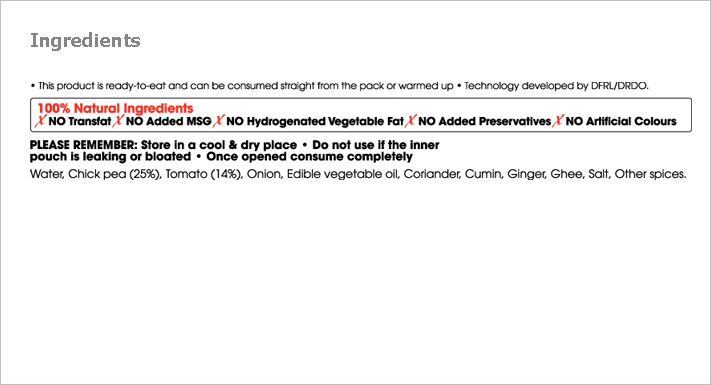
And given that MTR's products cost just $2.50 per pack where I currently live, $24 isn't exactly cheap. I haven't tasted your product, but I have tasted the MTR ones and they seem pretty authentic. And MTR being a very old, traditional brand, it's as authentic as it gets. Would love to hear about your differentiation strategy.
[1] https://www.mtrfoods.com/products/ready-to-eat