I mean one of them at least went ahead and wrote (technically is in the process of writing) an entire operating system from scratch in response.
I say this as someone who uses and has used linux as a daily driver for years now but honestly I don’t feel good about the future of the platform in the medium term at all.
If anyone has some time to throw at understanding why this is probably the single most sober and rational set of arguments I’ve found of the topic yet https://m.youtube.com/watch?v=WtJ9T_IJOPE
Sorry if this is a bit blunt, but I'm mystified by the description of that video as "sober and rational". I'm not a Linux fanboy at all -- I happily use my Mac and don't even own a Linux computer besides my Raspberry Pi -- and in fact I was looking forward to digging into that talk, but it's just a guy rambling extraordinarily slowly about a bunch of half-points for an hour.
The parts that I managed to endure were these:
"Some Linux figures are being cancelled, like Richard Stallman." Silence the pianos and with muffled drum... oh wait, actually, systemd will probably keep running and crons will keep firing.
"Linux companies undergoing changes." Where's Heraclitus when you need him?
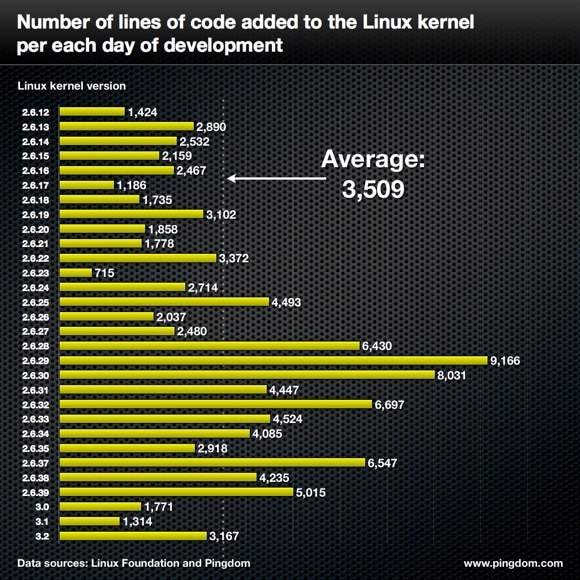
"Linux complexity increasing rapidly." He counts 2m lines of code added this year. But it's mostly drivers, and anyway this number has been trending downwards for a decade from what I can see (https://www.pingdom.com/wp-content/uploads/2012/04/linux-ker...).
"All Linux events are cancelled." Hmm, far be it from me to say, but I faintly recall that there was something besides Linux which might account for that.
"Google building Linux replacement." Google not building Linux replacement, Google building operating system.
"No operating system stays dominant forever." Linux is indeed not Ozymandias, sitting alone at the top of all creation, outside of space and time ... but I'm not sure how that means it sucks.
I wanted to like this, I honestly did, but the arguments are so dreadful that it feels like a deleted scene from one of Plato's dialogues. And Lord almighty he could have got to the point - such as it was - in much less than an hour.
I'm a huge Linux fanboy, who thinks Apple is evil and a puppet of the Chinese government and judge you for using Mac, and I totally agree. Lunduke is big on anti-SJW fearmongering, which I think projects a lot into his points. (He inductively applies that to society at large, which is the reason he gave for voting for Trump in 2020 lol.)
He used to have really good "Linux sucks" videos, which were actually tongue-in-cheek celebrations of Linux's progress combined with legitimate griping about the platform's issues.
The last two, though, have been identical pearl-clutching and doomsaying. You articulated my thoughts about them exactly. "These bad things are happening! We might actually not be using this 1970s OS 20 years from now. Better OSes might exist by then. But they'll probably be worse though! BUT people will use them anyway. It's all over. D: But is it actually all over? Maybe not. c: Who knows? I'm really scared though. But at least gaming is perfect on Linux now and all the old problems it ever had are gone. Pardon me while I fire up DOSBox."
It is easy and correct to critize that Lunduke's video. But the main point behind is that Linux project is becoming more corporatey, more windowsey and less user friendly and less small business friendly. New Linux drivers can't run perfectly fine 10 year old hardware (RAID cards, GPU cards) and users are forced to stay on old versions, or keep buying new hardware they don't need. That is not user or community friendly. But it is how Microsoft operates.
I'm a bit confused behind the substance of your argument. I use RHEL at work a lot which is admittedly pretty corporately, but use Debian at home just fine. But as for windows-y? How so? And regarding backwards compatibility, isn't that how Linux has always been? Windows has always been the king of backwards compatibility, whereas it wasn't one of Linux's strengths.
As Miguel de Icaza said in 2012:
> Backwards compatibility is not a sexy problem. It is not even remotely an interesting problem to solve. Nobody wants to do that work, everyone wants to innovate, and be responsible for the next big feature in Linux.
> So Linux was left with idealists that wanted to design the best possible system without having to worry about boring details like support and backwards compatibility.
> Meanwhile, you can still run the 2001 Photoshop that came when XP was launched on Windows 8. And you can still run your old OSX apps on Mountain Lion…”
Centos cancelled for the benefit of Redhat and detriment of many of its users.
Kernel changes that exclude users of 10year+ older hardware.
Corporate-backed campaign to discredit ethos leaders and defenders of user rights and veteran contributors - Redhat turning back on FSF and Richard Stallman, OSI banning Eric Raymond.
Ubuntu and Redhat losing interest in needs of desktop and small business users, putting most efforts into features for big cloud operations.
User group events degraded / cancelled.
Yeah Debian is still keeping mostly pro-user but they are not the leader in the cutting edge of development. Distributions innovating more do exist, but they are very small part of the Linux world. Most of it is Redhat, Ubuntu and hardware vendors.
Systemd, GNOME, GPU drivers are very windowsey; tightly coupled big software that one is discouraged to study and improve, almost as bad as their closed source counterparts on Windows.
I'm not sure what 'corporatey' or 'windowsey' means in the context of an operating system? Also, surely it's part of the nature of drivers that they are hardware-specific. Hardware changes a hell of a lot over 10 years. These complaints seem to describe issues with the way computers are architected and developed, more than anything in Linux itself.
The problem with old HW support is that the hardware is fine, the drivers are available and fine, but the kernel people decided to throw them out and replace by newer drivers which can run only newer HW products. Developers/vendors could be more user-friendly and keep support for the older hardware since the older compatible drivers exist, but they often don't.
What are these drivers you're talking about? Linux very rarely drops support for older hardware.
Things I remember off the top of my head in recent years: floppy boot support being removed, pre-ATAPI Matsushita CD-ROM support being removed, stuff like that. Turns out... you aren't going to be running modern Linux on systems that ancient anyway, because the minimum system requirements for just the kernel alone are already higher than machines of that era. So the number of people impacted by those cleanups should be ~0. Are you seeing drivers actively being used by people on modern kernel versions being removed?
You mentioned GPUs, but Nouveau supposedly supports Nvidia GPUs all the way back to the Riva TNT2 from 1998, and the Radeon driver should go all the way back to the original Radeon R100 from 2000. What are these unsupported GPUs you speak of?
Same with RAID cards; I see the driver for the Promise PDC20277 is still in mainline, and that's a PATA card from 2001 or thereabouts.
You can't endlessly upgrade software on ancient hardware; at some point the software outgrows it. Linux has historically been extremely good at keeping compatibility for old hardware, 20 years down the line. No other OS does that. But at some point things do have to go. I don't remember any time Linux broke something within a timeline similar to other OSes' support period.
1) dropping support of some Adaptec RAID cards in RHEL/Centos 8 with Linux 4.18. Like <= 5xxx series. Yeah, Adaptec 5x series is old and weak performance, but perfectly fine and widespread SATA controller card for servers. Many storage-oriented servers don't need anything faster.
2) Radeon RX4xx RX5xx GPUs worked on kernel 4.19, but they don't work for many people on newer kernels such as 5.10 and higher. Lots of error messages in dmesg, lots of reporting on forums, no official guide as to how to fix that. Amdgpu driver is in state of being endlessly rewritten presumably due to shiny new GPU cards and cutting edge Linux can't work with older cards reliably anymore.


I say this as someone who uses and has used linux as a daily driver for years now but honestly I don’t feel good about the future of the platform in the medium term at all.
If anyone has some time to throw at understanding why this is probably the single most sober and rational set of arguments I’ve found of the topic yet https://m.youtube.com/watch?v=WtJ9T_IJOPE