As a non-crypto-mining consumer, I've been frustrated by the price increase for video cards, and perhaps that frustration impacts Nvidia in the long run.
But really, when crypto was booming, what was Nvidia supposed to do? They were the guys selling shovels and pickaxes when the gold rush was in full swing. They rode the bubble and reaped the benefits when they could. So the price drop doesn't necessarily reflect a failure of strategy on their part.
What I'll be curious to see going forward is what Nvidia does with the cash from their bumper year. If the end result of this saga is that Nvidia lined their coffers and invested in R&D for the next generation of of video cards, that bodes extremely well for the company.
Not just is it intact, but is there really an alternative ML/AI platform out there? They're still the best (only?) game in town with the full stack. And you can go buy or lease access to their parts right now and get radical performance improvements for your model training.
kseems like a lot of startups are trying to build things equivalent to TPUs.
Also one can use FPGAs for inference(?) maybe also training?
I think a lot of people see an opportunity to try to take a slice of the big compute market for ML/AI. who knows if these alternatives really are viable....
but google has a lot of smart people and building your own silicon seems like a great idea these days..so I think other people will attack their stack.
AI is a pretty tractable workload for GPUs/TPUs/FPGAs. Inference is moving to many more places, the days of Nvidia being the solution for AI are over. It will still be the goto for research, but as things mature, the nets will literally run anywhere there is a MAC (multiply accumulate).
yeah, you have GPU like chips being developed by a lot of companies invested in AI. From server chips for training, down to cell phone chips for cheap inference.
I am really hoping to see AMD entering the battlefield. AMD GPUs are more than capable of handling the workload it is just a software problem.
It's not like Nvidia was trying to hold down expectations and the market went crazy anyway.
Nvidia based their own revenue guidance on the same assumptions about crypto mining that market analysts made. They missed their guidance in November because of that.
I think they are doing a pretty amazing job of controlling prices and inventory considering the recent craziness of the GPU market. They apparently sold all they could make at very high prices until a few months ago, and since then they seem to be trickling out their supply before releasing new mid range cards. I believe they have contractual agreements with card makers mandating price floors, and this seems to be working; two year old mid range GPUs are still selling at or above launch MSRP.[1]
The only cheaper deal is used (probably mining) hardware on ebay, still closing for %60-%75 of new launch price.[2] If there is really a glut, it sure isn’t reflected in consumer prices. Maybe the new big GPUs can use whatever production capacity isn’t needed yet for mid range products, and make up for lower volume with higher margins. It seems like AMD can’t really compete on efficiency right now – just price and raw performance up to whatever power limit consumers will tolerate (e.g. RTX2070 mostly outperforms Vega 64 with almost half TDP) so they can’t really compete on the high end. As far as I can work out Nvidia earnings aren't falling on low volume (yet); Q3 2018 earnings were up %2.[3]
>They apparently sold all they could make at very high prices until a few months ago
If that was the case they wouldn't have 90 days ( 3 months ) of inventory sitting in channels with high volume orders signed with TSMC until December. One of the reason I believe TSMC lowed their 2019 forecast was because AMD and Nvidia have too much inventory.
I agree, memes often don't contribute towards the discussion and add unnecessary noise: they just regurgitate what has already been said (the above meme is an example). I like the culture of Hacker News and its higher quality discussions and I don't want it to turn into Reddit. When I want to look at memes, I go to Reddit and I suggest the same to others.
I have lots of political opinions, which I enjoy expressing, and even the lame in-jokes on Slashdot were special in a sense. A lot of techies are quite witty, and humor is an essential part of human expression. I think that both of these things absolutely destroyed that forum, and that the rules are vital to the utility of Hacker News.
As you say, there are other forums which have fewer rules about self-expression -- and those forums provide a continually renewed justification for HN's content guidelines.
They didn't overbuild fabs during the gold rush, because they expected it not to last. This is one of the reasons for the GPU price hikes, and supply shortages over the past few years.
It was not hammered, it went way too high in the first place. Imagine someone wants to buy your house for twice the price because they expect the rent to double up. You'd happily sell it wouldn't you ? Then they realize the price isn't doubling up anytime soon ; they would either have to hold it for a very long time or sell it again for the original price. Yet nothing changed about your house, it's still brick and mortar.
That's what happens with those stocks. Companies like NVidia expect it to happen from time to time so the price itself doesn't mean much (if anything they will buy their own stock when at a low price and sell it at a high price). It doesn't change the value of the company (which may or may not be priced correctly by the market at any given time).
> "So our forward looking estimates when we set out our financial analyst model, it didn’t have crypto in it. It had growth through high performance CPUs, high performance GPUs, some of our base business. If we overlay some crypto on top of that, that’s great. And if crypto goes down in 2018, that’s totally okay, we have plenty of other growth drivers in the business."
http://cryptoblockchainresearch.com/2018/01/01/amd-crypto-ex...
Yes, their stock price is now back to June 2017. Not too bad.
NVidia may have focused on the high end too much. They have a card for the machine learning crowd that costs $16,000.[1]
The product they're now pushing to gamers, the 2080, is about $1000. It has some ray tracing hardware used by nothing. On existing games it's about the same speed as their 2-year old 1080, which NVidia just discontinued.
As a gamer, I'm torn on the rtx line. On one hand, it really is super expensive for an entertainment product that will be outdated in a few years. On the other hand, the exceptionally large die justifies that cost on a technical level, and raytracing in real time games is legitimately cool—much more so, IMO, then just another resolution or fps bump.
I certainly don't intend to upgrade, but I admire nVidia for the gutsy move, and I'm glad they're pushing the industry in this direction.
>It has some ray tracing hardware used by nothing.
Hard to fault this. It's reminiscent of when hardware transform & lighting (T&L) was introduced. Nothing used it until the cards existed, but the cards had to come along before anyone would bother coding it into the games.
For those who weren't around during the first wave of hardware 3D acceleration (circa 90s), there was a huge amount of "X brand only accelerates this and that game."
Nowadays, with DirectX and OpenGL (somewhat) winning the API war, a GPU is a GPU for all games.
It seems entirely reasonable raytracing hardware and game support follow the same path. Supported in some hardware, supported in some games. If the market likes it, over time we see fewer and fewer games that don't use it.
* Caveat: Things are a little different this time since DirectX 12 supports Ray tracing today, as far as I can tell. And Microsoft doesn't really care who wins between Nvida and AMD (aside from keeping suppliers in competitive bidding for XBox GPUs).
That caveat makes the entire analogy wholly inapplicable. nVidia is using standard graphics technologies that AMD + Intel will eventually be able to implement in their own hardware, down the road. Games that support raytracing on rtx cards today will also support raytracing on future AMD cards.
Exactly. The question at this point is: what's their patent situation like? They may be able to stop competitors from implementing the same technologies - which would clearly be a pretty worthwhile thing.
> If the market likes it, over time we see fewer and fewer games that don't use it.
You can use accelerated lighting even in a 2D game, but I'm unclear on what casual games would be using ray-tracing for. Have a particular vision of the future you'd like to share?
If you are developing a AAA title with "hyper-realistic graphics" or a more artistic, cinematic game you can use raytracing to achieve effects which are otherwise 'faked', give you unique effects, or just to get more dynamic lights in scenes.
Indies and less realistic or more "casual" games may not bother with it, just as many of them don't bother with things like parallax mapping and some don't even bother to use textures at all. The features are there and easy to use but developers opt in and out of the different rendering options based on their artistic styling.
Heck man, in the 90's, the most popular card [0] was a 3d only card. you still needed a regular video card for 2d. And yeah, apps had to be custom written to work with it.
It made sense at the time: everyone's computer already came with a 2D card (since integrated video wasn't a thing yet. Everything was cards.)
There was no pressing need to replace your 2D card, and in fact you might actively dread it (drivers were finicky back then—replacing your 2D card was signing up for a process not dissimilar to that of building a Hackintosh today.) And computers back then had a lot of room and a lot of spare PCI slots. So why not buy a separate card just for 3D, leaving your existing 2D card intact? Smaller change to worry about.
> drivers were finicky back then—replacing your 2D card was signing up for a process not dissimilar to that of building a Hackintosh today.
Hmm, certainly in the 80s and maybe very early 90s but by the time Voodoo cards came along things were much better. Still not up to the "plug and play" level of today, however.
Used by nothing right now. The lineup of upcoming rtx games at nVidia's press conference was pretty substantial, it's just that most of them aren't out yet.
What is missing right now are games that are designed for RTX & DLSS (but they are coming), full of mirrors and shiny objects. All the games that are out use RTX to enhance the experience, which means that Ray Tracing is secondary citizen. Atomic Heart is an example of a game that really depends on Ray Tracing heavily for the best experience.
Unsure - When havoc physics (for example) came on the scene, the usual hype curve of adoption played out where there were were super gimmicky games that required it and relied entirely on game mechanics being pegged around the physics capabilities. It was a short-lived phenomenon. But, today, having that kind of physics engine and capabilities is part of a toolkit that developers draw upon, and many consumers expect to be included, rather than being a single central focus.
I'm predicting this will be the same kind of story playing out again - One vendor kicks it off, some 'demo' games that build heavily on it drop but are quite short-lived, and the tech slowly turns into a commodity feature with in-game settings menu 'on/off' selectors, followed eventually by ubiquitous support to the point that nobody really talks about it any more, it's just part of 'modern graphics'.
Shaders is another good example that followed that kind of pattern, it was all the shit in the late 90s that Q3 had 'shaders', now it's not even a bullet point for most releases, but it's certainly there.
I've rambled, but my point is that I'm not sure a lynchpin 'RTX required' game is needed at all to drive industry-wide adoption here.
Sounds interesting. An interesting difference between RTX and the previous techniques is that ray tracing is needed for modern film rendering. It just doesn't make sense that movies are still rendered with CPUs and not a more parallel architecture, so it feels for me that games are just a secondary for NVIDIA for the current version of the card.
No, I really think the situation is better than that. If you view the ray tracing as "something extra", almost like when shaders were first "invented". You use them to add softer shadows. Caustics. Interesting volumetric tricks. And people will just want them.
I am a little torn, too. I built a new machine recently and went with the 2080 (Stepping up to the 2080ti when they become available).
On one hand, there is the appreciation for the technical achievement of something that seemed unlikely for a while (real-time ray tracing), plus as you mention, then increased die size. They look to be pretty good for ML applications, as well.
On the other hand, there is the increased price and, frankly, underwhelming results. The only game that uses the RTX feature suffers substantial performance penalties for turning on the RTX feature and most people (including me) just try it out for a few minutes and then turn it off. Is the quality better? Yeah, the reflections are shaper and more consistent when changing views (ie, aiming down a sight), but they aren't game-changing and are definitely not worth the performance penalty.
This generation of cards is worth skipping if you aren't building a new computer.
Call me Debbie Downer, but I'm still of the opinion that real-time raytracing has yet to prove itself. Most of the examples I've seen achieve effects which have been imitated by faster, more portable techniques for years, and - for the most part - have been still scenes with static lighting, which hasn't been a problem since Quake 2.
Having played the same game in both modes, there are definite improvements to the quality with this method. Like I said, in most situations without ray tracing, when you do things like look down the scope of a gun, the reflections are lost, but not with RTX. The reflections are also much crisper and more dynamic.
That said, this comes with a pretty big cost, both in $$$ and performance. If this could be accomplished without the substantial performance hit that it seems to come with, then it would be fairly impressive and worth the $$$.
I'm betting the real killer app will be a game that centers around environments with lots of liquid-solid transitions. Maybe you'd manipulate and move various liquid and gel materials around in zero-gravity, or something. Maybe an "infinidistillery" sequel to Infinifactory.
Or, come to think of it, a "Half-Life 3: Portal 3" where you use gravity+portal+various paint (and other liquid) guns, on an alien ship and in space, would make a lot of sense...
I'm kind of with you, partially. Game devs have gotten really, really good at faking reflections. It's not always accurate to real life, but I don't notice.
I personally do think the raytracing footage we've seen is a significant step up, however.
Oh no doubt that it is, but games artists have made pretty convincing imitations of it for so long now that to see a real difference would require removing all the previously bespoke baked-in details. I'm sure artists are simultaneously relieved and saddened by this.
However, nothing will be the step up that bumpmapping brought to the table. Doom 3's textures look like garbage with that disabled, due to the bump/normalmapped greebles all over them. Everything looks like clay or cardboard.
Built mine with a 2080 as well, was able to get one for $700 which is about the same as a 1080ti which was my original plan. RTX doesn't matter for me but the deep learning enhancements and their effects on frame rates are interesting.
>raytracing in real time games is legitimately cool
I may be (read am) an old git, and ray tracing just makes me think Wolfenstein 3D. I assume this is a different raytracing? Is it the origin of the rays rather than coming from the 'eye', coming from the light source? Isn't that inefficient?
Or something else???
I'm simplifying, but Wolfenstein's technique is called Ray Casting, which calculated the player's view by drawing lines from the player's "eye" to objects and walls in the field of view and use that information to calculate distance and perspective.
Ray tracing has been around for forever, but was too resource-intensive to use in real-time until recently. It calculates the path a pixel/light source takes, allowing for realistic lighting (including bouncing off of surfaces) and perfect reflections.
According to the wikipedia ray casting article, the two were used interchangeably "in early computer graphics literature", just to make me feel even older.
One of the differences nobody mentioned yet is that Wolfenstein 3D was based on 2D ray casting. It’s much less common to use the term “ray tracing” for two-dimensional rays, and more common to use something more generic like “ray casting” in that case. This is in addition to how the WP article mentions that “ray casting” is currently referring to visibility testing, and “ray tracing” is more often referring to a specific rendering algorithm.
> The big difference is ray casting is just along a line, not on every pixel.
I think you have it backwards. Ray tracing is O(#of pixels*number of light bounces). More common 3D rendering is based on O(# of objects in the scene). It's conceivable that ray tracing can be more efficient for scenes with many objects.
It's essentially the same process to begin with (I think), but every time the ray hits something you fire off secondary rays probabilistically from the hit point to see what that point is receiving light from, and so on ad infinitum. Usually you're calculating a BSDF[1] for each surface you hit, which tells you where to cast your next set of rays.
Ray tracing produces the best results for complex dynamic lighting. This is why it's used for example in movies. It's also normally done on the cpu which is slow rtx is supposed to do something with specialized hardware on chip which is much faster although games would have to build Nvidia specific features which doesn't bode well.
I'm past the edit window, but tiny self-correction: I probably should have said "hardware agnostic APIs" instead than "open APIs". DirectX isn't "open" per se, although it depends on your definition.
Don't be torn on the RTX line, be practical. The RTX 3080 or RTX 4080 will be amazing. By that time they'll have fixed the initial performance issues and software will be generally available that actually takes advantage of it.
Now's a great time to find a used 1080 or two for cheap.
Don't buy the first generation of anything unless you've got money to burn. Get the second or third.
What parts are worn out, and how does this affect performance and remaining lifespan? I guess I can see that fan bearings and the like may have physical wear, but I'm surprised that "digital" wear would be a major problem.
> NVidia may have focused on the high end too much. They have a card for the machine learning crowd that costs $16,000.
Here's the thing about gaming vs content creation vs ml pricing -- they're fundamentally different activities from a financial standpoint.
Gaming (for the VAST majority) is a cost center. How much are you willing to spend on it?
Content creation, and now ml, are profit centers. How much do you make from it?
The latter question is directly related to your business. If you're running financial trading models and the card makes you 5% faster, that 5% may be worth USD$1M. If you're running a 1 acre farm, maybe it's worth $3.
But by hardening and popularizing CUDA and GPGPU, Nvidia upscaled their most wealthy buyer from sfx studio to any company that makes predictions.
It's a heck of a lot easier to deliver 1% improvement to a $100M company, than to deliver a 200% improvement to a $500k company.
> NVidia may have focused on the high end too much.
seems to me like they're making products available at all sorts of price points. i'm not an mba, but that strikes me as a good idea.
not making quite enough mid-level products is unfortunate, but since that was temporary, it wouldn't have made sense for them to invest in increased production.
(they should've abandoned the MSRP and just reverse auctioned inventory to the retailers, so that they could capture the value of their products, instead of letting folks selling on ebay get it.)
> They have a card for the machine learning crowd that costs $16,000
Yeah, I wish they'd just sell a high-power but essentially commodity card with, say, double the 1080's power.
But it's in my interest to want maximum bang for my buck and it's in Nvidia's interest to extract maximum money from it's customers. The only escape would be if AMD comes up with an equivalently powerful card and I haven't seen an indication of this happening.
But yeah, it's hard to see them at any risk unless they really mismanaged their capital investment, which is always a risk for companies like this.
They sell what you're asking for... it's 2 1080's in SLI. It takes twice the power and makes twice as much heat, but you'll save $200 over the 2080ti.
If you want to double the framerate you are getting with a 1080 and be on one physical card, with reasonable power and heat, that is the 2080ti.
If you ignore the ray tracing and machine learning features, this is still what you're asking for, is it not?
Or do you mean, you want to pay the cost of a 1080, and get a card twice as good as a 1080? Because i would also love to trade my leaf for a tesla but pay nothing...
What I meant was basically I wished they stuffed more cores where the ray tracing stuff is in the 2080 and sold it for the same price. Obviously, that may not be a decision particularly in their interests. The only way it would be would be if they had a competitor that would do that. Now, they add audience specific bells-and-whistles to each chip and sell the chips at price they calculate each audience will pay. They do have to recoup the truly vast expenses involved in developing this stuff.
And sure, I want to Moore's Law pricing overall. Even if each generation is twice the power of the last generation, I still want each generation at the same price. But again, only with competition.
is it that simple though? maybe raytracing is more power (so heat) efficient, and simply putting shader cores there wouldn't give the frame rate increase you want.
or perhaps you're right and it's divide and conquer plain and simple.
> They sell what you're asking for... it's 2 1080's in SLI. It takes twice the power and makes twice as much heat, but you'll save $200 over the 2080ti.
SLI/CF never scaled linearly and in modern games (if they support it at all) you're usually looking at 10-30 % performance increase, for twice the cost and introducing microstuttering.
Yhe ML quote is from dell and looks to be 'appropriately' dell priced at ~50% markup vs mass retail..
but yes $8-10k is still alot.
That said, if you need this stuff and your super fast $5k workstation is basically an otherwise 'worthless' I/O pump to the GPU, it's still worth the price tag.
$1000 dollar card is an ~800mm2 Die with 8GB GDDR6. Yes the Die is only 90% enabled, but $1000. If you look at what Intel is selling you in terms of Die Size per dollar, and comes without High bandwidth GDDR6 Memory, the 2080 looks like a bargain. I would be happy if Intel sell me a ~700mm2 Die for $1000 without memory.
I was initially thinking the same on Ray Tracing. But having seen more videos and more tuning so less performance loss when using RT, I am now fully convinced Ray Tracing is the future, and it is achievable. The next 5 years, 7nm, 5nm and 3nm from TSMC is going to make RT Gaming Everywhere.
So they've had an upwards trend in the past. That's no guarantee for future performance.
> Ignore the crypto bubble/pump and NVDA is growing quickly
Quoting the article: That bust is obvious in Nvidia’s revenues this year: they are essentially flat for three quarters now, hovering between $3.1 and $3.2 billion.
No the uptrend is not just in the past, it's still continuing today. Just in the past year went too euphoric.
We need to be able to distinguish between the 2 tailwinds. AI and crypto. Crypto turned out to be more of a factor than analysts anticipated, leading to the huge runup and then fall. Consider that done and dusted.
However the AI story is consistent and strong. Now that the stock price has come back down to earth we're still looking at amazing returns, there's nothing to be displeased with here.
The Q/Q performance is not concerning because of the product cycles. Every generational change there was a big drop in sales of the previous generation. Look at the first quarter of Pascal and first quarter of Maxwell's introduction and you'll see the same pattern. A flat quarter is actually an amazing improvement over the straight up declines of the previous generations.
Major growth will return soon as new products get ramped.
Clearly any stock that does not price into it the eventual heat death of the universe (and hence zero residual economic utility) is the product of irrational euphoria in the market...
Nokia also had an upwards trend year after year, until they didn't.
I acknowledge that the recent stagnation might only be short-lived, but it would be premature to call this new trend temporary based on the past performance.
At the very least, we know that the environment has changed significantly, because the Crypto cash cow seems to have stopped producing milk.
Also, their P/E is at an healthy 19.99, reasonable.
The article says that Apple is making their own GPUs, that doesn't matter, because Apple is not a nVidia client for a very very long time, and was never a big client.
The others are even less suitable comparasion as those companies aren't making GPUs and they are not just going to walk in that market.
If there is a company behind the "cryptocoin", they can fall back on their primary business of releasing another “cryptocoin”. The sells are revenue. They haven't sold any equity yet, and if they did it would still be a growth story and nobody would care about how they actually made money. They have no debt, have sold no equity, and they have revenue from their zero cost basis crypto. They experience a slowdown from sales but are immune from the "bear market".
The "cryptocoin" itself functions more like a commodity, a market which was never for the passive retail trader because there is no expectation for commodities to increase in value indefinitely, only in ebbs and flows based on supply and demand. So the prevalance of the retail trader in the cryptocoin market explains the misaligned value ideas, which are mostly analogies to a stock market. Oops. Although stocks are the only capital market prevalent amongst retail, try not to get the asset classes confused.
"Cryptocoins" typically have a more transparent supply than non-digital commodities, and upgrades to their utility are also typically in open source projects which means these provides advantages in determining price targets in the future value and the scale of the addressable market participants. As in, how much any future market participant will want to own to access a provision provided by the network. As open source projects, and freely fungible, you can create utility for a new market until your positions are profitable, with near zero overhead costs.
I am still amazed that after all this time otherwise smart people cannot understand that cryptocurrencies are simply fiat money with bad guarantors.
Instead of the government of the United States or China or Britain or India or some other actual entity that is highly likely to survive nearly any catastrophe or change in leadership, cryptocurrencies are backed by shady MLM hucksters who originally met on a minor and very geeky gaming BBS to come up with their scheme, and whose downline marketers hire C- and D-list celebrities to shill for them. You don't even end up with a garage full of awfully-scented soap when it crashes.
Passive investing in misnomers are the main problem. As you are spot on: there are no coins, currencies. As my previous post mentioned, there are no/few tokenized companies trading either.
But your disdain is still too broad and blanket.
There are plenty of ways to be productively deploy resources for profit in that market. Its typically just not a directional/long-only passive approach, it is more actively creating an asset and market until you are satisfied. Just like in other markets.
The GTX 1070 launched in June 2016 with an MSRP of $379. Typical prices at the end of 2018 for that same product are above $400 even after the newer RTX 2000 series has launched.
I and pretty much every other PC gamer I know have been holding off buying upgrades until prices come back to some level of sanity. I don't understand how Nvidia (and EVGA, XFX, MSI, Zotac, Gigabyte, etc) can keep trying to sell at these absurd prices then turn around and complain about how not enough people are buying them or they don't make enough money.
Have their costs unexpectedly shot up on their two-year-old manufacturing processes? Or did they just bank on the crypto bubble to prop up inflating GPU prices forever and were surprised when it didn't happen?
Going forward they've doubled down on even higher prices for next generation, with versions of the RTX 2070 currently at $500 to $600.
EDIT - I should add, my first thought on this was that gamers are no longer a market that Nvidia cares about, and they're hoping that high prices will still sell to the machine learning (where people are frequently spending someone else's money on a large quantity of cards) and cryptocurrency markets. Then crypto dropped out, and ML are considering other options even if Nvidia are the top performers.
But the RTX series is pitched for realtime raytracing effects in upcoming games, which sends the message that they do take gaming seriously. But I think they're out of touch with how much people are willing to spend on it.
I think a lasting effect of the crypto craze is that it showed enough gamers were willing to pay higher prices that nvidia shifted the prices of its card up by a few hundred bucks.
The RTX 2xxx series has been really disappointing from a price/performance aspect.
I'm looking forward to seeing what AMD has up their sleeves for their next generation. I don't expect it to compete at the very top end performance, but I'm betting the performance per dollar will be more in my ballpark.
> Have their costs unexpectedly shot up on their two-year-old manufacturing processes?
The price doesn't reflect what it costs them, it reflects what they believe they'll make the largest profit margin on.
> Or did they just bank on the crypto bubble...
It's investors that were banking on that. Share price doesn't say anything about the success of a company (except for ability to raise money), it's just a consensus of estimates about future value.
NVidia are still very successful in their original niche of making graphics cards, and haven't sacrificed this in favour of crypto.
Nvidia was banking on the crypto bubble too, they overproduced graphics cards and then took 300,000 of them back from an OEM partner because the market was saturated.
To me, that says "priced too high," they might be making great margins but they couldn't sell all of them. I probably would've bought one if the price were more in line with the GTX 900 series. At this point I'm hanging on to see how AMD looks, either for getting one of their new cards or hoping they can put some pricing pressure on Nvidia.
Agreed. I'm sticking with my GTX 960 that I got for under $200 new three years ago. I haven't seen anything with a better performance per dollar ratio than I got at that time. Anything I buy would be a downgrade by that metric.
What? You can get GTX 1070's for $200-$250 right now off ebay. Admittedly used, but crypto mining doesn't harm a card that much. If you want new, GTX 1060s are going for under $200$.
Then again, AMD's making pretty bold claims about their pricing for next year, so you could hang on.
Is that really a good idea? A miner's incentive is to overclock the cards and run them as hard as they can before dumping the nearly fried hardware on some unsuspecting sucker. No way to check whether they've been run in reasonable temperature and voltage ranges, and no warranty either. That seems like a gamble, but I suppose that's why they're cheaper.
Definitely planning to see what AMD has coming. I'd like to have the Mac + eGPU option open when my Wintendo kicks the bucket, and AMD are the only ones supporting that right now.
Actually most miners have tried to get the best possible hash per kilowatt ratio out of their cards, which makes sense given that electricity cost is basically the main cost of their business. And the best ratio isn't achieved by overclocking and -volting, but by undervolting and underclocking.
Very constant workload, way below peak capacity - I bet that crypto usage does put much less wear and tear on the chips than heavy gaming use.
> It takes a lot for a company to lose nearly half its value in such a short period of time, but Nvidia is proving that an otherwise strong technology business can disappear in a blink of an eye.
Conflating the stock price with the company's business/book value multiple times seems like probably not an accident for a financial reporter. Is there some agenda here to frame/spin the story this way?
I'd argue they didn't really lose half their value, they lost half their stock price. This may seem like a distinction without a difference, but remember stock price isn't really THE value, it's a valuation, and in this case that valuation was inflated, incorrect. Their value is still there, it doesn't appear that they lost any significant market share, and in fact there's plenty of growth to be had in emerging AI and autonomous driving applications in the long term.
I think that most commentators are getting lost in the chaos that is cryptocurrency. For me, cryptocurrency is an accidental fad that will dissipate. Nvidia is still growing in AI applications.
They got swept up in the crypto bubble, are at $150 now after a high of $300-ish, but were $20-30 in 2015 before all that. So with the "crypto depression" this is to be expected.
But the question I find more interesting is what this does to a company. Is it even plausible for them to go back to just running the company as though it were worth $20-30 and pretend it never happened?
Or are they going to have investors who bought in at 2-3x that price at best screaming for them to inflate their stock by whatever means necessary?
I think the market gave too much weight to crypto with regard to Nvidia. The growth story for the company is still there.
The article is talking about other companies designing for their own custom needs, but I think the mindshare has largely already been captured by Nvidia. Why? Because their software stack, even with its quirks, is still better than a lot of what else is out there. In the current marketplace, deploying custom GPU solutions without Nvidia products is really painful and something only someone who enjoys pain would undertake.
> Is it even plausible for them to go back to just running the company as though it were worth $20-30 and pretend it never happened?
Your math is way off, they don't need to pretend nothing happened and go back to $30 / share. The crypto bubble (now imploded) isn't why they're still generating $4 billion in annual profit ($1 billion in operating income last quarter). It's not a critical part of their business; in actual numbers it was a modest party on the side for several quarters and some investors had hoped it would be more than that. The removal of the crypto boom from expectations, is causing a let-down in the projected upside in the stock and their business. Crypto wasn't 3/4 of their business, or the last quarter results would have shown that type of destruction.
Your $20-$30 share price would peg them at a $12 to $18 billion market cap. They could justify that with just the earnings from their latest quarter.
Nvidia made strategic decisions when the crypto craze was beginning not to play into it, anticipating that exactly what happened was going to happen. I doubt this recent jump and fall of the stock has had much of an effect internally.
Is this actually a problem for Nvidia? I'm sure they knew that the buttobitcoin craze wouldn't last forever and would eventually result in a stock price fall. They made vast improvements in their technology and raked in money. That that ride wasn't sustainable isn't a big deal if they didn't make investments that depended on the bubble never popping.
If I was an investor I'd be pissed, but only because investors want prices to rise regardless of any underlying physical reality, but the executives should be laughing all the way to the bank. It's just a post bubble correction.
It can be a problem if ownership changed a lot during the craze and new owners can't stand the idea of being the ones left holding the bag. Suddenly there will be pressure to do insane bets and suicidal short term magic that would not be there if the hype had never happened. Call it residual irrationality of you like.
They still make about 9 Billion a year...I think CUDA/CUDANN is probably one of their highest "money making" product. Seriously locks down so many applications that needs to use their card exclusively. OpenGL development seems slow too so I guess Nvidia has a little bit of time before they have to worry too much.
$12.4 billion in sales the last four quarters, $4.5 billion in operating income.
Their business situation is fine, entirely without the crypto market. Intel saw little growth for many years, while generating immense profit, and while the multiple that investors were willing to give them compressed. Intel will soon have a 10-12 PE ratio. The entire semiconductor industry saw a dumping in the stock market, blamed on an industry down cycle. Micron is trading for three times earnings as another example. nVidia was up at ~43 times earnings before the drop, very rich for the industry. Now they're down closer to ~22, which is a lot closer to fair value based on their reduced growth expectations.
The issue that the article entirely ignores, is valuation compression with a stock market that decided to dump some rich multiple stocks (Netflix is down ~35%) and particularly semiconductor stocks. That's how you lose half your valuation in a few months.
For employees this is a real roller coaster ride. If you had a industry-standard $500k RSU component over four years, four years ago, you were recently walking around with 7 million dollars, depending on your sell or hold preferences. Whereas now you merely have 4 million. On the other hand if you started a month ago with the same deal, now you have much less than the industry standard deal.
I bought a lot of nvidia at $30 for three reasons — machine learning, VR, and cryptocurrency. I sold most of it around $180-$200, but I’m still holding some shares.
It's still a great buy in my opinion, especially after this correction. People were piling on for the crypto craze, but the fundamentals for $NVDA are still really good. They've got a mountain of cash, very little debt, and an unmatched product line.
Others are designing their own chips right? How about Nvidia up their game and provide an IaaS or design a decent mobile product? That could be a move.
Their customers are IaaS providers. That would be extremely dangerous for them and a step too far probably. I have hope they'll get back into mobile eventually with the advent of Windows-on-ARM.
Their focus right now is rightly on the AI software stack. That's where the value is going to be generated in the future decade and NVDIA needs to make sure all that value is generated using their platform. There are so many verticals that will be buying products, so much money to be made. They're also heavily investing in autos, but tbh that's just 1 vertical and imo not even the most exciting one.
Verticals like healthcare, restaurants, home robot servants, logistics, photography, constructions, are even more exciting and lucrative.
The explosive rise of Fortnite last year coupled with the popularity of streamers like Ninja to elementary school kids, had me convinced that a boom in gaming pc market was coming and that it would more than make up for the loss due to crypto mining. I know exactly zero people that crypto mine, Yet I know several kids who lack machines to play fortnite properly but watch everything related to the game and lust after there own machine.
So actually having a couple of years of extremely good sales is bad for companies, if they are registered on the stock market? I have trouble processing that information.
But why should a couple of good years get a company into trouble? It is inevitable that sales can not always stay as high.
I could understand if NVidia would have done some kind of investment that was only sustainable if the good times would continue the same way for a while.
But it seems to me they will just continue to make good graphics cards, as they did before. So why should they be in trouble?
> I'm not sure Nvidia is in trouble. Investors who overestimated their future performance.
The problem is that management did not do enough (as far as investors were concerned) to temper market expectations. It may have been they truly did not know who was buying their product, and they believed most of their clients were coming from ML and gaming, when instead it was heavy, heavy crypto.
Other than that, as the article mentions, it was trade tensions that turned the quarter miss into a perfect storm for a sell-off.
Only one comment in this thread mentioned VR in passing.
Some years back it seemed to be a decent possibility that GPU manufacturers could benefit from VR's huge appetite for GPU performance. How does HN feel about that now? Has VR turned out to be just a flash in the pan, and not a serious market for GPU manufacturers after all? Or is there still hope?
MSFT keeps on surprising me, since nearly everybody I've talked with who's on or tried Azure says it is a complete dumpster fire. The acquisition of GitHub was super smart though, and I am willing to bet as we look back it be hailed as a great move.
If Nvidia are to get back in the game they need to price their product right. Having products that cost as much as the rest of the rig is simply idiotic. Their mobile chips have always been problematic. Remember the MacBook Pro failures a few years ago? Those were Nvidia's GPUs.
As long as they can cut back orders to fit the market without coin mining, then they will drop back to a higher point on the growth curce after the crypto surge has been trimmed.
So they whould be fine. The fantasy growth from crypto is vaporware...
When it comes to owning next-generation application workflows, Nvidia is facing robust competition from startups and established players who want access to this potentially gigantic market.
Am I the only one who cringes when someone says or writes "application" but actually means "datacenter" or "internet service"? The author is clearly not talking about Mobile or Desktop Apps here.
And even with that term cleared up, WTF are "next-generation application workflows"?
Regardless of your preferred terms of art, Tensorflow (as an example) is an application, and a deployment that uses Tensorflow to intuit product recommendations (as an example) is an application workflow.
It doesn't really matter what kind of device the program runs on. It's running in userspace: it's an application. It does not function in a vacuum: it's part of a workflow.
Can you point me to any references for this definition of application? I have never heard TF being called an application. I'd call it a library or a toolkit but maybe these terms aren't en vogue these days.
(Software) Application to me means quite literally any (software) work that "applies" technology to solve a concrete end-user problem.
But I guess you're just proving my point: If we use your definition of application the quoted article text is essentially meaningless since "application workflows" could mean almost anything and NVIDIA certainly isn't in the business of competing for almost anything. If we use my definition the author has just misused the term.
I'm agreeing with you that 'application workflow' can mean almost anything. I'm strongly disagreeing that nVIDIA isn't in the business of competing for almost anything -- that's exactly what they're doing. It doesn't really matter what your use case is, the nVIDIA sales team has a CUDA (or NVLink, or Tegra, etc) story for you.
No they're not. For instance they completely turned their backs on Mobile (Tablets, Phones, Wearables, Laptops, etc.) and there's no indication they are coming back any time soon.
I know because at some point my company was one of their largest individual SHIELD tablet customers. That is, until they stopped making them and asked us to find another supplier.
It's interesting to me how "value" seems to work - nothing has been physically destroyed, the products still exist and in fact they are still being made; the already purchased capital (fixed and variable) is still there - so what's been lost? Is it a purely speculative quantity? If so, shouldn't we ask why we are attaching so much significance to something which has very little bearing on what we, as humans, do: production?
I hear you. But the point of the stock market is not to produce things, it's to oversee the allocation of resources to other market sectors (which actually do produce things). To make a computer analogy it's sort of like an operating system scheduler, it uses economic resources to better allocate economic resources.
Value here is a proxy for predicted success which then translates to access to resources. Not directly, but markets with lots of predicted success then have access to investor capital. Also companies can own their own shares, and often do use those shares to get access to new capital, and companies can be purchased by larger companies, giving them more capital to work with.
I agree it's pretty stupid, but it works. Check out prediction markets for example. That's not to say that it's efficient by any stretch, but allocation of resources is NP hard, and this algorithm works well with humans.
As capricious as markets are, that's a pretty loose definition of "works". All too often, equity markets are just a force multiplier for herd mentality, and end up being actively antithetical to actual value and resource allocation.
"In the short run, the stock market is a voting machine. In the long run, it's a weighing machine." -- Benjamin Graham
One other property of markets is that they're very good at transferring wealth from those who get caught up in the herd mentality to those who do their own research and hold their own opinions. This may be bad for wealth inequality, but it does make them self-correcting when it comes to human emotions.
Antithetical as compared to what? Markets are imperfect, but consistently drive innovation and improvement that benefits consumers. What's your better alternative?
Not really. Whether something "works" or not is a relative thing. If it works really well compared to all the alternatives, it's not a loose definition of "works." Yes, markets suffer from imperfect information and various other ailments. You can find issues with the solutions to all problems, and while it's occasionally interesting to talk about those problems, the real question is whether you can find better solutions.
Personally I don’t think the parent comment is confused. The stock lost half it’s value, but the company did not.
Book value is the term for assets minus liabilities, so “value” without qualification tends to imply all types of value at once. The term “company value” used at the end of the article might even tend to imply more book value than market value to the average techcrunch reader. I suspect the author intended to conflate them in order to paint a picture that is more negative than the real story.
He definitely conflated market value with book value when he wrote “Nvidia is proving that an otherwise strong technology business can disappear in the blink of an eye.” That line is more or less pure hyperbole.
If we want to be really specific, hasn't only NVIDIA equity lost half the value. I'm pretty sure other portions of the capital structure are largely unblemished.
> If so, shouldn't we ask why we are attaching so much significance to something which has very little bearing on what we, as humans, do: production?
Production is what most humans spend their working days doing or supporting or contributing to.
In the case of company value, investors care not only about what the company is worth today but also about what it will be worth in the future. It makes sense that lower sales result in a lower stock price despite the fact that the products and current capital are unchanged.
Example, people can value something very highly but not have funds to buy it, someone who can afford the price easily can value something as being of little worth, but due to their wealth they can afford it.
You appear to be confusing price, ability to pay, and value.
Do look at art. You can buy a hugely influential piece of art and not value it at all, you buy it as an investment but don't care about its innate qualities, its influence on the art world (directly, only indirectly by the price that confers) or it's cultural worth.
What has been lost is confidence. High stock valuations boost the wealth effect. This has a real impact economic activity. It's not just NVIDIA, a lot of tech stocks have tanked and the market in general is close to turning into a bear.
Part of the worry is all the used GPUs that are going to come on the market since it doesn't make sense to mine anymore (or less sense). Their core business will be depressed until that is worked through
Market cap is a predictive valuation of future income, more or less. The fact that it has gone down reflects negative investor sentiment about future income, not that they had a warehouse fire.
The difference is, in the Nvidia example, it IS just the markets, valuing a company that produces actual physical products, and sells them for billions of dollars. The market is a vague guesstimate of what the actual company will do in the future.
When it's bitcoin, the product's value is literally equal to the market price.


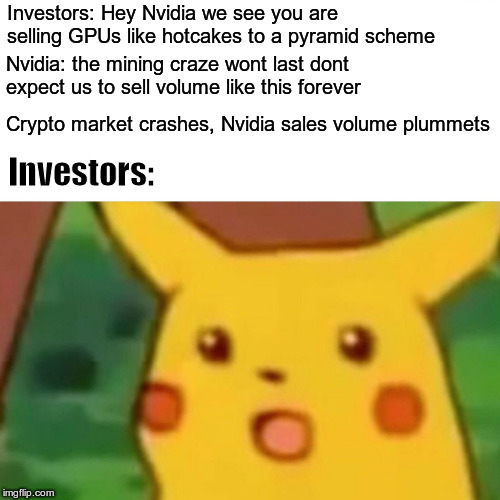
But really, when crypto was booming, what was Nvidia supposed to do? They were the guys selling shovels and pickaxes when the gold rush was in full swing. They rode the bubble and reaped the benefits when they could. So the price drop doesn't necessarily reflect a failure of strategy on their part.
What I'll be curious to see going forward is what Nvidia does with the cash from their bumper year. If the end result of this saga is that Nvidia lined their coffers and invested in R&D for the next generation of of video cards, that bodes extremely well for the company.